
Hello everyone! In today’s blog post, I will be discussing about our last week’s mini group presentation topic. All groups did a great job presenting their points last week! In this post, I will be explaining from my own perspective and also summarises some of the points that we all mentioned in class!
What is Infocomm Media Development Authority (IMDA)?
The IMDA is of paramount importance when it comes to the media in Singapore. They are the statutory board of the Singapore government. All sorts of media related stuffs such as our local broadcasting company, Mediacorp and also media organisation, Singapore Press Holdings (SPH) have to go through the IMDA as they regulates the converging of media information. The IMDA also works with private media companies to broadcast informative information to the audience in Singapore.

Government Owned Media
In my opinion, the media owned by the government provides us with more reputable and reliable information.
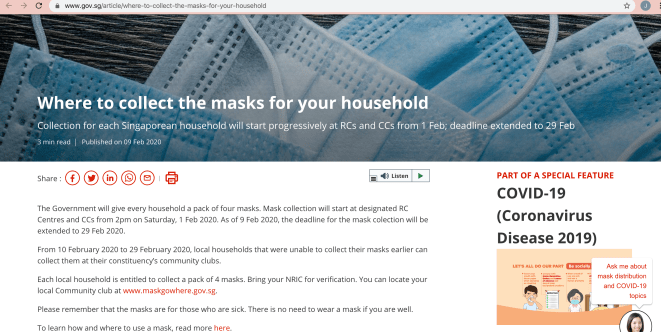
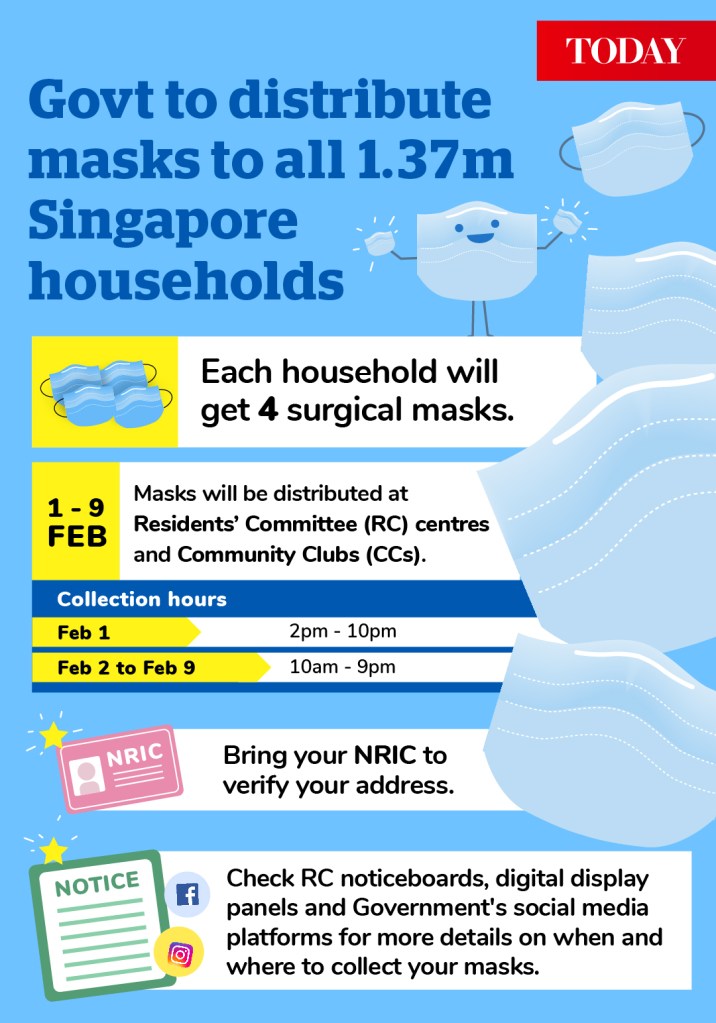
An example would be the recent information on collection of face masks. The local news and government website informed us on where we can collect our free face masks. This information is authentic and reliable as it is a direct mouthpiece from the government. Personally, I will trust the government website more as I believe that the facts they provided us are what they think is best for the country.
When there is a crisis going on in a country, many people will go out of control. Some will even come up with nonsense logic and ideas and spread them to the community. In return, this will only worsen the situation. This shows that if there is no one decent channel that we all can trust and rely on, people will all start believing different facts, and not knowing what is right or wrong. Hence, I believe that a media channel owned by the government can be the main source of information for the citizens. Simultaneously, they can also keep the country in place.
Furthermore, most of the contents published by the government owned media are more family-friendly. Explicit contents are not shown when you are watching the news on TV with your family. Also, if the particular show is not suitable for a certain age group, there will be a film classification warning. This enables parents to be more cautious about picking shows for their children to watch.

Private Owned Media
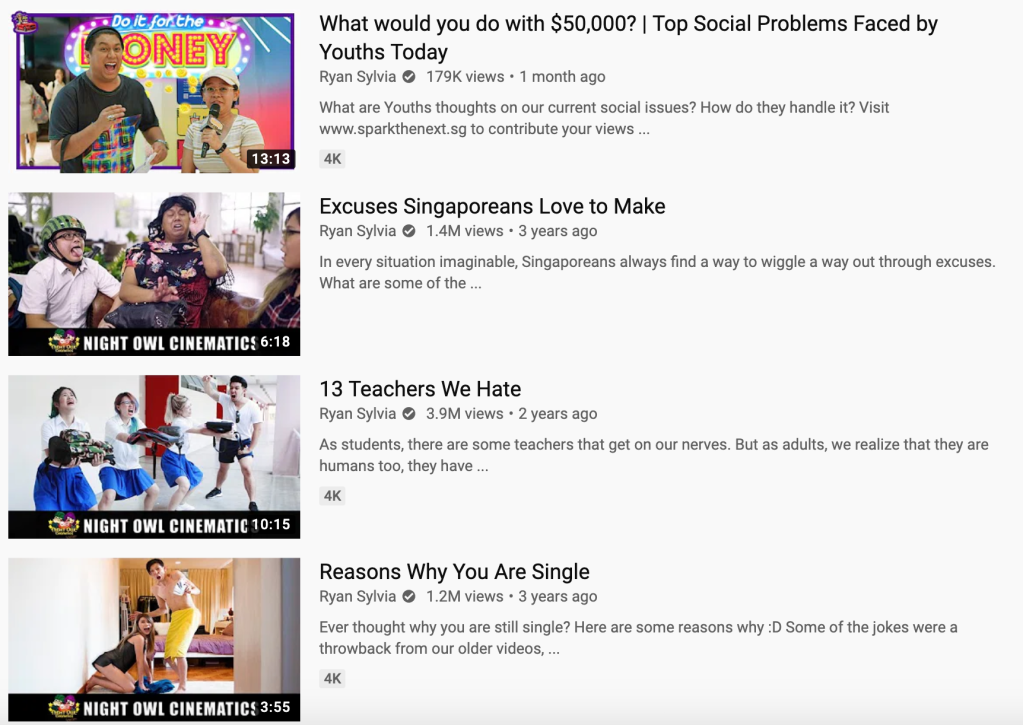
These companies or organisations have their own private ownership, which means that they have the rights to choose what they want to broadcast. With that, I feel that private owned media tends to broadcast things that are more appealing and relatable. Youtube channels such as Night Owl Cinematics and The Smart Local post videos about the local’s public opinions, or even a typical thing that Singaporeans can relate to. They published it in a more entertaining and laid-back way that I believe will make the audiences feel a deeper connection and relatedness.
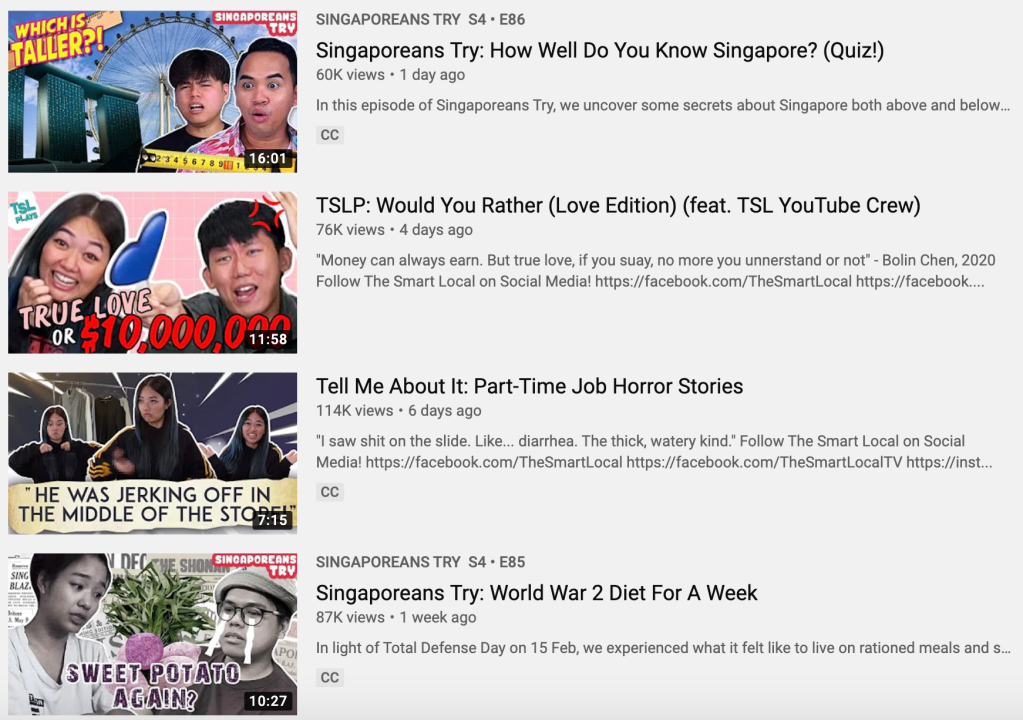
https://www.youtube.com/user/TheSmartLocal
https://www.youtube.com/user/Alozerk
Both of these channels published a variety of videos that are relevant in a Singaporean’s daily life. I feel that this can also mean that such channels are more interested in generating profit. This is because the more supporters they have, the more videos they will post, even to the point that they will post anything that they assumed the majority of audiences will like. The downside to this is they might end up posting false information, spreading it to the public.
Here is something you will find in a typical Singaporean’s WhatsApp family group.
Random texts, videos and links sent from your aunties and uncles without a valid source.

Since this form of media outlet advocates the freedom of speech, people can say whatever they want as there is no one controlling them. They can spread rumours and say their political opinions on things that they dislike or disapprove. Personally, I will not admit that some of these information are completely wrong, but I think that these information are not trustworthy enough. If everyone starts trusting on different random sources, isn’t that going to make everyone feel more confuse and panic? I also feel that credulous people will most likely fall under the trap of fake news. My mom tends to be easily convinced by such texts that were forwarded without a valid source, while my dad always like to say my mom is too gullible to even believe such news. This overload of information makes people unsure on who or what to believe in, and even make some people to not even want to trust anything at all.

Back to the main question… Does it matter who owns the media?
Yes, it does matter. From my perspective, the government should own the media. The IMDA is the regulator for our media content in Singapore. Without it, the media content in Singapore will be overloaded with an unsystematic of media content. Also, since Singapore is a multi-racial and multi-religion country, guidelines and policies should be implemented by the IMDA so that no racial or religious groups will be offended or criticised. Additionally, a small country like Singapore will be in haywire if false crisis message was spread. With government owned media, sources are more reliable and it keeps this small country in harmony and in place. We should also educate ourselves on what sources to believe in, so that we can be more informed of what the actual news are.
Thank you for reading! 🙂
References
IMDA – Infocomm Media Development Authority. (2020). Retrieved 19 February 2020, from https://www.imda.gov.sg/
Where to collect the masks for your household. (2020). Retrieved 19 February 2020, from https://www.gov.sg/article/where-to-collect-the-masks-for-your-household
Govt to distribute masks to all 1.37 million Singapore households amid Wuhan virus outbreak. (2020). Retrieved 19 February 2020, from https://www.todayonline.com/singapore/govt-distribute-masks-all-137-million-singaporean-households-amid-wuhan-virus-outbreak
File:Singapore Film Ratings.png – Wikimedia Commons. (2020). Retrieved 19 February 2020, from https://commons.wikimedia.org/wiki/File:Singapore_Film_Ratings.png

 jy
jy 

Hi JY, I loved reading your post. The fact that you have used local examples has made it relatable. And the COVID-19 example you have used is very recent and hence essential. You have segmented each part of your post. That makes locating the main points easier.
One thing I felt is that since we have already discussed about Singapore’s media, you could have used at least 1 other country as a model for either private or government owned media. Other than that this blog pot is simple and contented hence educating this topic well.
The debate that you have put forward is also strong and stern, making your points valid. Looking forward to more of your posts. Good Luck!
LikeLike
Hello JY! A great way to sum up what was covered in last week’s presentation! Your group really went down deep into the details of IMDA regulating our media. Good research there as it helped me understand the workflow on how media is being processed and regulated before it is presented to the public on broadcasting platforms.
I liked how you added a screenshot of your family’s group chat. My family’s chat group is also filled with quite a bit of unreliable media that sometimes cause panic and confusion. Even worst, private own companies asking people to donate money for a certain cause (e.g. to help with Australian bushfires). I am glad that I am educated on how to view media objectively and slowly guide my family on how to question the sources they see before believing it. The situation isn’t that bad now! 🙂
All in all, a great post! I enjoyed it. Looking forward to your next!
LikeLike
Hi JY!
I really liked your example about the family group text (I mute mine so I don’t have to read the garbage they share). I love my country and I genuinely believe that the government has our interests as their priority, hence I don’t think government regulations on media is any kind of emergency.
With that said, you could argue that the reason your aunties and uncles are sharing fake news, is because their generation grew up without conflicting opinions. They literally grew up in a state where there was only one source of information, compared to us where we’re used to having multiple opinions in our hands. You could even say that negotiating a message rather than having it spoon-fed is a survival skill for us. So while government-owned media may be better for them now, maybe they are like this because of government-owned media.
Looking forward to your next post!
LikeLike
Hey there J.Y! This is a well detailed blogpost you have written. It informs me of the drawbacks and the advantages of each types of media, and you made it more relatable through the use of recent local events. I do agree that people do easily get influenced by the any sort of controversial news that fiddles with their emotional state, especially the pioneer generations of Singapore. Thus, it is vital to relay trustworthy media content to viewers! However, one must also realize that there are chances in where the government has the power to hide their misdoings if they were to have the ownership of the media, so yes there are pros and cons to these issues, but overall a job well-done on your blogpost I must say!
LikeLike